

From Generational Trauma to Forgiveness: What Family Sagas Teach Readers
57
reads
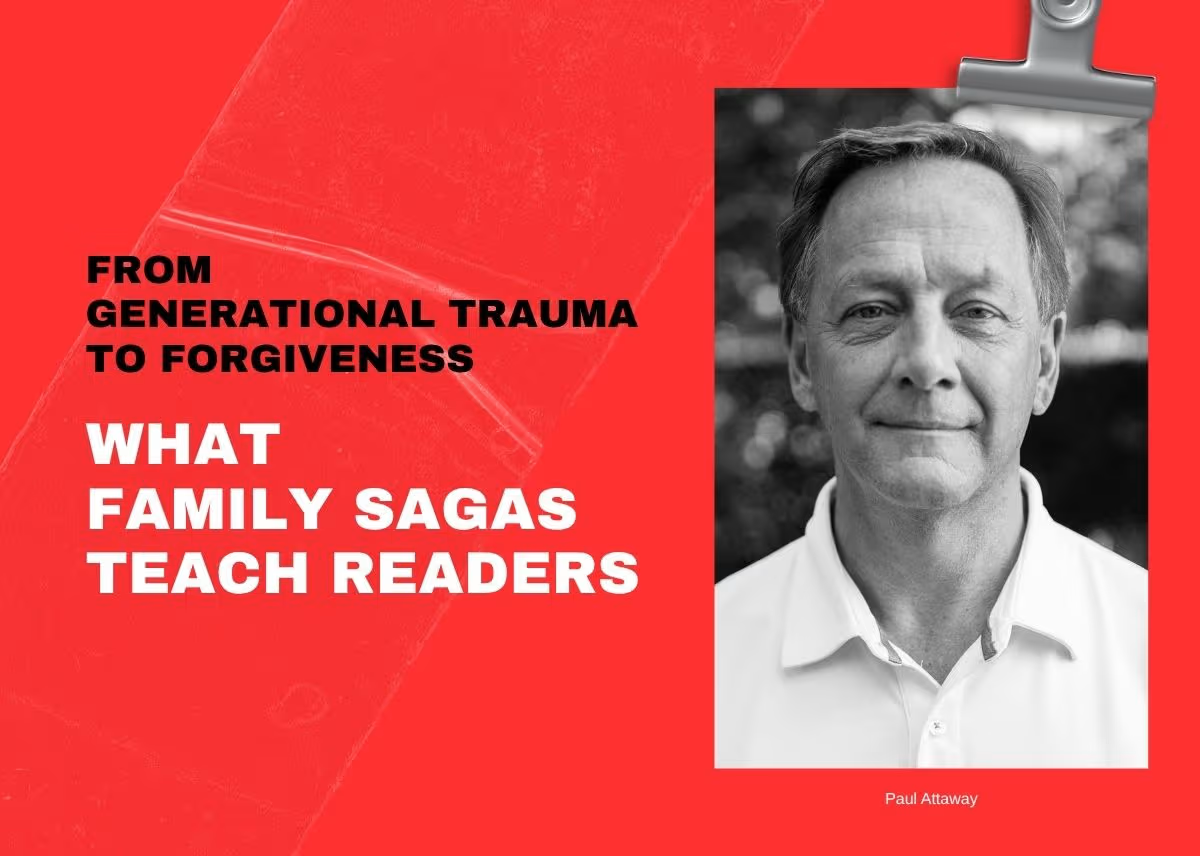
Family sagas endure because they give private wounds a larger context. A family’s history can explain present-day behavior, reveal why relationships fracture, and show how decisions made by one generation can affect the next.
For Paul Attaway, these themes form the foundation of his Atkins Family Low Country Saga, a series of Southern family dramas that combine crime, suspense, family secrets, betrayal, and moral reckoning. Set primarily in Charleston, South Carolina, the series examines how the past continues to influence people long after the original events have occurred.
At the center of Attaway’s Southern fiction is a fundamental question: How can a family heal when its members have inherited wounds they did not create?
Table of Contents
What Is Generational Trauma in Family Fiction?
Generational trauma describes the way the effects of painful or destabilizing experiences can influence later generations. In fiction, this can appear through family secrets, unresolved grief, distrust, emotional isolation, destructive behavior, or relationships shaped by events that occurred before a character was born.
Family sagas are particularly effective at exploring generational trauma because they allow readers to follow consequences across time.
Rather than presenting trauma as an isolated event, a multigenerational story can show how one decision changes a family’s relationships, how parents’ fears affect their children, and how concealed truths eventually become part of the next generation’s identity.
Attaway uses this structure throughout the Atkins family story. The central crimes matter, but their emotional consequences are equally important. Characters are forced to live with events that reshape their relationships, identities, and understanding of their families.

Blood in the Low Country: How Family Wounds Shape the Next Generation
Blood in the Low Country, the first novel in the Atkins Family Low Country Saga, introduces Monty and Rose Atkins and their sons, Eli and Walker, in 1973 Charleston.
The immediate conflict begins when Eli is accused of murdering his girlfriend. The accusation puts the family under enormous pressure and forces them to confront questions about loyalty, reputation, truth, and responsibility.
Yet the novel’s deeper psychological conflict comes from Rose’s past.
Rose experienced a traumatic childhood and becomes determined to build a better and more socially secure life for her children. Her desire to protect her family is understandable, but it also demonstrates how unresolved pain can influence the way parents raise their children.
This makes Rose more than a supporting character in a murder mystery. Her history becomes part of the psychological inheritance passed to Eli and Walker.
Attaway has explained that the “blood” in Blood in the Low Country refers to family and to the history of one particular family reaching from the past into the present.
That concept is central to the novel. The murder investigation provides the Southern crime fiction framework, while the Atkins family’s history provides the emotional foundation.
The question is not simply who committed a crime. It is how a family’s past shapes the people who inherit it.
Can Forgiveness Heal Family Trauma?
Stories about family healing and forgiveness often confront a difficult distinction: forgiveness does not necessarily mean forgetting.
Forgiveness can coexist with accountability, boundaries, grief, and an honest recognition of what happened. In family fiction, this creates a particularly powerful source of conflict because characters must decide whether reconciliation is possible without denying the damage caused by the past.
Attaway explores this tension most directly through Eli.
Eli’s Redemption: Betrayal, Forgiveness, and Rebuilding Trust
In Eli’s Redemption, Eli leaves Charleston after being falsely accused and betrayed. He eventually creates a new identity in the Bahamas, attempting to separate himself from the family history and events that transformed his life.
But physical distance does not resolve emotional trauma.
Eli must eventually confront the relationships and experiences he attempted to leave behind. His journey becomes a story about betrayal, identity, forgiveness, trust, and redemption.
The central question becomes whether a person can move forward without pretending that the past never happened.
That is what makes Eli’s Redemption more than a continuation of the family mystery. It becomes a story about the psychological consequences of betrayal and the difficult process of rebuilding a life after trust has been destroyed.
Kirkus similarly described the novel in terms of heartbreak and forgiveness, highlighting the role of dark secrets in its emotional and suspense-driven narrative.
Eli’s story demonstrates an important principle of family sagas: forgiveness is often a process rather than a single decision.
The character must understand what happened, determine what can be repaired, and decide what kind of relationship with the past is possible.
The Difference Between Forgiveness and Reconciliation
Family fiction can also challenge the assumption that forgiveness automatically leads to reconciliation.
A person may forgive without restoring the relationship to its previous form. Likewise, reconciliation requires participation from both sides, while forgiveness can be an individual decision.
This distinction is important in stories about generational trauma because families often contain multiple versions of the same event.
One character may see an action as betrayal. Another may see it as protection. A parent may believe they were shielding their children, while the children experience the same behavior as secrecy or control.
Attaway’s fiction creates space for these competing perspectives.
His stated approach to storytelling also reflects this emphasis on character and consequence. “As a writer, I view myself as a storyteller first and a writer second,” he has said.
Rather than presenting moral conclusions directly, his novels allow questions about loyalty, forgiveness, responsibility, and family obligation to emerge through the choices his characters make.
What Psychology Can Teach Us About Family Forgiveness
Contemporary psychological research adds complexity to the question of forgiveness.
A 2025 multi-phase study involving 288 adolescents examined parental apologies and found that the way an apology is communicated can affect forgiveness, relationship satisfaction, and perceptions of parental authority.
At the same time, research published in 2026 has explored circumstances in which refusing forgiveness may itself have psychological benefits. This complicates the popular idea that forgiveness is always necessary for healing.
That distinction is particularly relevant to family fiction.
A character does not necessarily heal by simply forgiving another person. Healing may instead involve establishing boundaries, acknowledging harm, accepting responsibility, rebuilding trust, or choosing to move forward without reconciliation.
These possibilities make family sagas effective vehicles for exploring emotional questions that do not have simple answers.
Blood Rivalry: When Family Secrets Become Inherited Power
Attaway extends the themes of family history and inherited consequences in Blood Rivalry, which moves the Atkins saga forward fifteen years.
Walker Atkins is now a lawyer, and his professional investigation brings him into conflict with the politically powerful Dunsmore family and South Carolina Governor Johnny Dunsmore.
The story expands the series’ focus from personal trauma to political corruption, inherited power, family secrets, and institutional influence.
The consequences of hidden wrongdoing are no longer limited to individual relationships. They affect political institutions, professional lives, and the wider community.
This development demonstrates how family secrets can evolve across generations. What begins as a private decision can eventually become part of a family’s public identity.
Walker’s investigation also places him in a different position from the younger character readers encountered earlier in the saga. He is now able to examine family history through the perspective of a lawyer, bringing questions of evidence, accountability, and justice into the story.
Why Southern Family Sagas Are So Powerful
Southern family fiction has a long tradition of examining the relationship between family identity and the past.
Southern Gothic fiction often focuses on the contrast between respectable appearances and hidden dysfunction. Family names, social status, history, and tradition can provide a sense of identity while simultaneously creating pressure to conceal uncomfortable truths.
Attaway uses these conventions within a contemporary Southern suspense and crime fiction framework.
His novels demonstrate why family sagas remain compelling: readers are not only interested in what happened. They want to understand why people behave as they do and how the consequences of one generation’s choices affect another.
That makes the family itself part of the mystery.
A murder may initiate the investigation, but the deeper mystery can be the emotional history that made the characters who they are.
What Readers Can Learn From Paul Attaway’s Family Sagas
The Atkins Family Low Country Saga offers several recurring lessons about generational trauma, family relationships, and forgiveness.
The past does not disappear simply because it is hidden. Family secrets can continue influencing relationships even when younger generations do not know the full story.
Protection can become another form of control. Parents may believe they are shielding their children while inadvertently passing their fears and unresolved trauma to them.
Forgiveness does not require forgetting. Characters can acknowledge harm and still consider whether forgiveness or reconciliation is possible.
Trust must be rebuilt through action. After betrayal, relationships cannot simply return to their previous state because someone wants them to.
Family loyalty has limits. Protecting a family member can conflict with the need for truth, accountability, and justice.
Inheritance is emotional as well as material. Children inherit names, memories, expectations, relationships, and sometimes unresolved conflicts.
These ideas give Attaway’s Southern family dramas relevance beyond their crime-fiction plots.
The Enduring Appeal of the Southern Family Drama
Paul Attaway’s Atkins Family Low Country Saga demonstrates why stories about family trauma and forgiveness continue to resonate with readers.
Blood in the Low Country establishes the family history and the trauma that threatens to shape the next generation. Eli’s Redemption explores betrayal, identity, forgiveness, and the possibility of rebuilding trust. Blood Rivalry expands those themes into political power, corruption, and the consequences of inherited influence.
Across the series, family history functions as more than background. It is an active force shaping character decisions.
Attaway has said that storytelling has “the power to speak to us at so many different times in our life and to do so from so many perspectives.” His family saga illustrates that idea by allowing different readers to see the same family conflict through different emotional lenses.
A parent may identify with Rose’s desire to protect her children. A child may recognize the consequences of that protection. A sibling may understand Eli differently from Walker. An older reader may recognize consequences that younger characters cannot yet see.
That is ultimately what makes the Southern family saga so enduring.
A small-town Southern mystery may begin with a crime, but its most important questions can concern identity, memory, forgiveness, and the emotional inheritance passed from one generation to another.
Through the Atkins Family Low Country Saga, Paul Attaway turns those questions into stories of suspense and redemption, showing that confronting the past may be painful, but refusing to confront it can shape a family for generations.
Related Posts You May Like
-

Unlocking The Anti-Aging Potential Of NMN
1610 reads
-
7 Richest Casino Winners in the World
1692 reads
-
The Best Things To Do In Salt Lake City
100 reads
-

Linebet sports betting site in Bangladesh
1495 reads
-
-